
Summary
Highlights
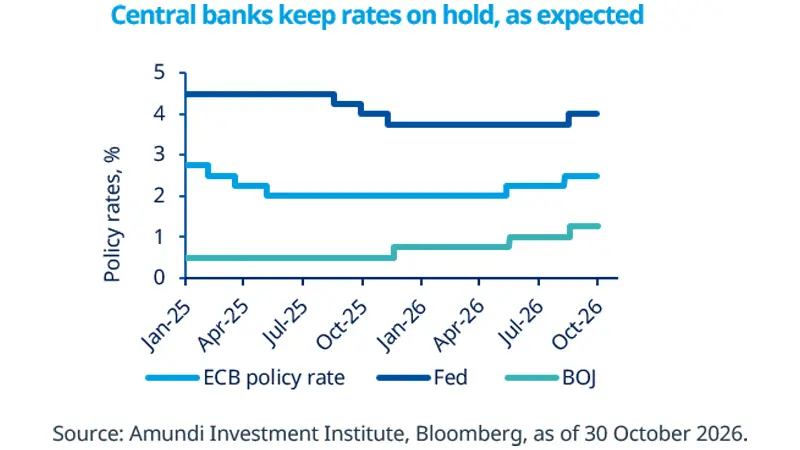
The Fed, the ECB and the Bank of Japan (BOJ) kept rates on hold at their October policy meetings.
This decision to wait allows the Fed and the ECB to assess additional data before acting in December.
Uncertainty over their future policy decisions remains high, as central banks would like to tame price pressures without crippling economic activity.
In this edition
Major central banks, including the Fed, ECB and BOJ, kept their benchmark rates unchanged last week. The Fed seems to be assessing the effects of its rate hike in September and believes financial conditions are tighter today than they were previously. However, Chair Warsh was categorical in saying that conditions are not tight, the economy is strong and inflation is “too high”. We think the Fed is buying time and has left the door open for a hike in December this year, although it declined to provide any forward guidance. We also think that one of the reasons the US economy is staying strong is AI and related investment. In the long term, this should improve productivity across the economy, but in the short term all that heavy spending is creating strong demand for AI products and infrastructure, which may be pushing up inflation. The ECB also kept rates steady and believes financial conditions have tightened. Higher energy prices, along with the risk of second-round effects from energy prices and wage pressures, both of which are contained for now, will drive the bank’s decisions in December and next year.
Key dates
2 Nov Japan PMI Manufacturing, India PMI Manufacturing, US ISM Manufacturing | 4 Nov US ADP Employment, China PMI Services, India PMI Services | 6 Nov US Nonfarm Payrolls, Unemployment Rate, and University of Michigan Consumer Sentiment |
Read more