
Summary
Highlights
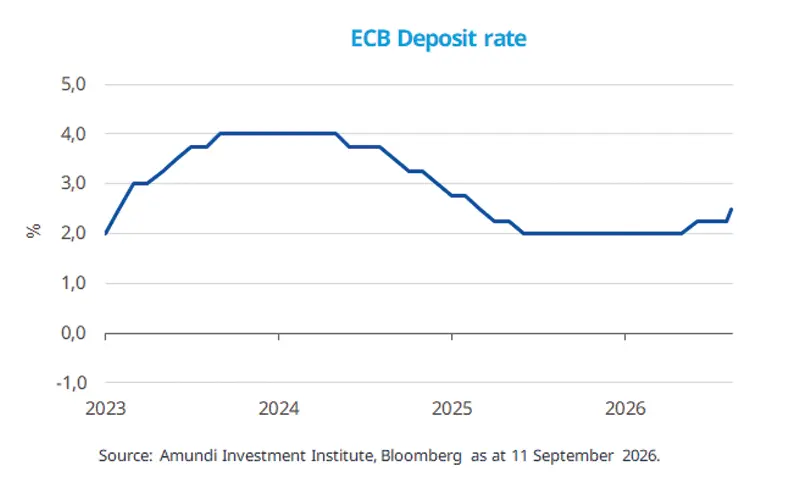
The ECB raised rates to 2.50%, remaining determined to deliver on its target of price stability in the medium term.
The ECB raised inflation forecasts for 2027 and 2028, reflecting for 2027 expected high level of energy prices. Growth forecasts were also revised up for 2026 and 2027, reflecting greater resilience.
With yields under pressure, also amid inflation risks, a flexible approach to fixed income is paramount.
In this edition
At its September meeting, the ECB raised policy rates by 25 basis points and reaffirmed its data-dependent, meeting-by-meeting approach, with no pre-commitment. The decision was unanimous and was considered robust across the ECB staff’s three alternative scenarios. The ECB said inflation risks are tilted to the upside and growth risks to the downside, particularly amid conflicts in the Middle East and between Russia and Ukraine. Lagarde sounded hawkish, stressing that while inflation has surprised to the downside, especially in food prices, it may prove more persistent than previously expected. Lagarde also noted that indirect effects remain limited and that no second-round effects have emerged so far, although a prolonged energy shock could increase risks, including to food prices. With tensions in the Middle East persisting, risks in the Red Sea rising and oil and gas prices increasing, inflation is likely to remain the dominant consideration for the policy outlook.
Key dates
UK CPI, Eurozone industrial production, Fed policy rate, Brazil policy rate |
Eurozone CPI, BoE policy rate, US initial jobless claims and housing starts |
UK retail sales, US industrial production, BoJ target rate, ECB CPI expectations |
Read more