
Summary
Highlights
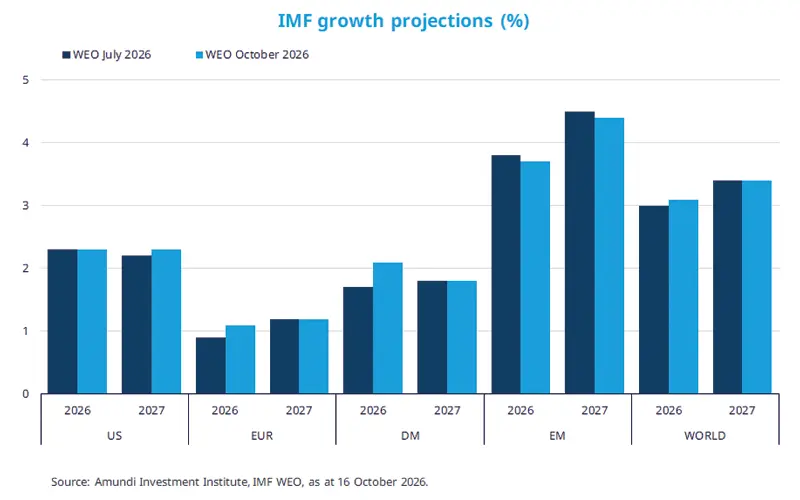
The IMF raised its 2026 global growth forecast to 3.1%, up slightly from July, with 3.4% projected for 2027 — driven largely by the AI investment boom.
Resilience is still the key message, but it is not unlimited. The IMF suggests a shift from coping to rebuilding, with a focus on supply-side resilience, fiscal repair and price stability.
Looking ahead, supply resilience and policy discipline will drive growth, inflation and asset allocation.
In this edition
The IMF held its Annual Meetings in Bangkok this week, releasing its World Economic Outlook. The Outlook highlights that the global economy has remained resilient, albeit unevenly, but the room for further adjustment is now more limited. Potential constraints could emerge in energy and other commodities, which have benefited so far from rerouting, substitution and efficiency gains, as well as technology-related investment. This could lead to more persistent inflation. Looking ahead, the IMF stresses the need to move from coping to rebuilding, in terms of supply-side resilience, restoring fiscal space and keeping monetary policy focused on price stability. It also warns that the financial system needs to be reinforced to create buffers against future shocks. Over the medium term, the IMF suggests that greater resilience will require more technological and trade diversification, as well as stronger supply buffers in critical sectors such as energy.
Key dates
19 Oct China GDP, Retail sales and Industrial production, US Housing Market Index |
21 Oct UK CPI and PPI, Indonesia policy rate |
23 Oct Japan CPI and PMI, India PMI, Euro Area PMI, ECB inflation expectations, US PMI and Consumer Confidence |
Read more